
Defining the_avant-garde_


Avant-garde (French pronunciation: [avɑ̃ɡaʁd]) means "advance guard" or "vanguard".[1] The term is used in English as a noun or adjective to refer to people or works that are experimental or innovative, particularly with respect to art, culture, and politics.
Avant-garde represents a pushing of the boundaries of what is accepted as the norm or the status quo, primarily in the cultural realm. The notion of the existence of the avant-garde is considered by some to be a hallmark of modernism, as distinct from postmodernism. Many artists have aligned themselves with the avant-garde movement and still continue to do so, tracing a history from Dada through theSituationists to postmodern artists such as the Language poets around 1981.
Making Sense of Marcel Duchamp

Fauvism is the style of les Fauves (French for "the wild beasts"), a short-lived and loose group of early twentieth-century Modern artists whose works emphasized painterly qualities and strong color over the representational or realistic values retained by Impressionism. While Fauvism as a style began around 1900 and continued beyond 1910, the movement as such lasted only a few years, 1904–1908, and had three exhibitions.[1][2] The leaders of the movement were Henri Matisse and André Derain.
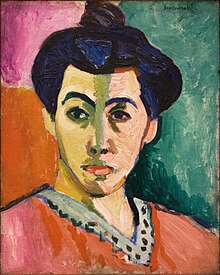 |
| Henri Matisse, Portrait of Madame Matisse (The Green Stripe), 1906, Statens Museum for Kunst, Copenhagen, Denmark |
Visual communication as the name suggests is communication through visual aid and is described as the conveyance of ideas and information in forms that can be read or looked upon. Visual communication in part or whole relies on vision[1], and is primarily presented or expressed with two dimensional images, it includes: signs, typography, drawing, graphic design, illustration, colour and electronic resources. It also explores the idea that a visual message[2] accompanying text has a greater power to inform, educate, or persuade a person or audience.
Art for Art’s Sake
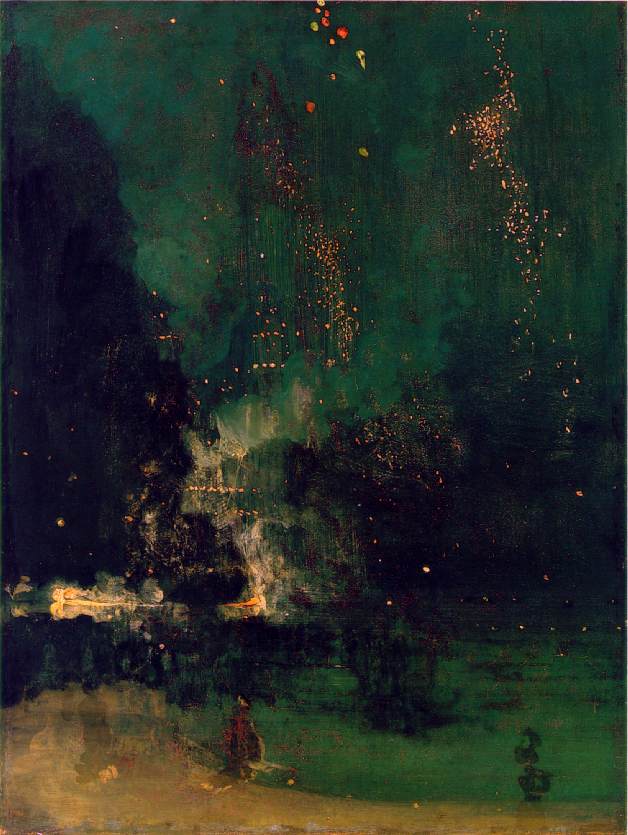 |
| Whistler Nocturne in Black and Gold: The Falling Rocket (1875)
two approaches to avant-garde art
2. art that seeks only to expand / progress what art is (in itself and for itself) / art for art’s sake |
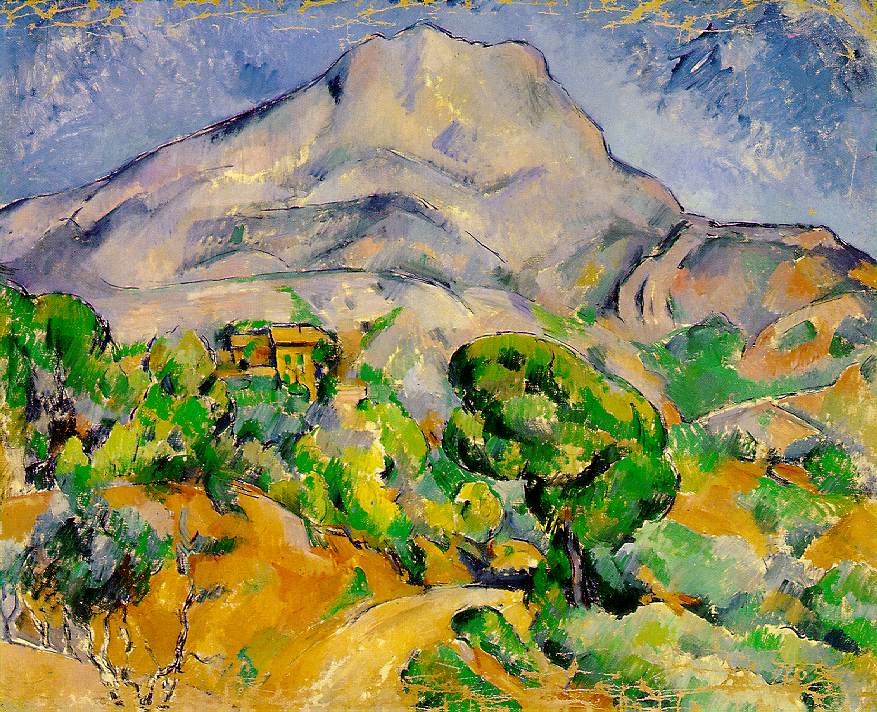 |
| Cezanne Mount St. Victoire (1900)
The “Art
for Art’s
sake” approach dominated much thinking and
practice in 20thC art
|
Clement Greenberg (January 16, 1909 – May 7, 1994) was an American essayist known mainly as an influential visual art critic closely associated with American Modern art of the mid-20th century. In particular, he is best remembered for his promotion of the abstract expressionist movement and was among the first published critics to praise the work of painter Jackson Pollock.
-lavender-mist.jpg) |
| Pollock Lavender Mist (1950)
Christopher "Chris" Burden (born in Boston, Massachusetts in 1946) is an American artist working in performance, sculpture, and installation art.

Chris Burden shot
Socialist realism is a style of realistic art which was developed in the Soviet Union and became a dominant style in other communist countries. Socialist realism is a teleologically-oriented style having its purpose the furtherance of the goals of socialism and communism. Although related, it should not be confused with social realism, a type of art that realistically depicts subjects of social concern. Unlike social realism, socialist realism often glorifies the roles of the poor.
|
 |
|
Vladimirski
‘Roses for Stalin’ (1949)
Constructivism was an artistic and architectural philosophy that originated in Russia beginning in 1919, which was a rejection of the idea of autonomous art. The movement was in favour of art as a practice for social purposes. Constructivism had a great effect on modern art movements of the 20th century, influencing major trends such as Bauhaus and the De Stijl movement. Its influence was pervasive, with major impacts upon architecture, graphic and industrial design, theatre, film, dance, fashion and to some extent music.
|

Kitsch (English pronunciation: /ˈkɪtʃ/, loanword from German) is a form of art that is considered an inferior, tasteless copy of an extant style of art or a worthless imitation of art of recognized value. The concept is associated with the deliberate use of elements that may be thought of as cultural icons while making cheap mass-produced objects that are unoriginal. Kitsch also refers to the types of art that are aesthetically deficient (whether or not being sentimental, glamorous, theatrical, or creative) and that make creative gestures which merely imitate the superficial appearances of art through repeated conventions and formulae. Excessive sentimentality often is associated with the term.
The contemporary definition of kitsch is considered derogatory, denoting works executed to pander to popular demand alone and purely for commercial purposes rather than works created as self-expression by an artist. The term is generally reserved for unsubstantial and gaudy works that are calculated to have popular appeal and are considered pretentious and shallow rather than genuine artistic efforts.
The concept of kitsch is applied to artwork that was a response to the 19th century art with aesthetics that convey exaggerated sentimentality and melodrama, hence, kitsch art is closely associated withsentimental art.
.jpg/220px-The_Widow_(Boston_Public_Library).jpg) |
 |
| 'The sensation of these pieces was that they come above your ankles, as if you were wading in bricks', Andre has commented. 'It was like stepping from water of one depth to water of another depth.' This was the last in his series of Equivalent sculptures, each consisting of a rectangular configuration of 120 firebricks. Although the shape of each arrangement is different, they all have the same height, mass and volume, and are therefore 'equivalent' to each other. For the Love of God is a sculpture by artist Damien Hirst produced in 2007. It consists of a platinum cast of a human skull encrusted with 8,601 flawless diamonds, including a pear-shaped pink diamond located in the forehead. Costing £14 million to produce, the work went on display at the White Cube gallery in London in an exhibition Beyond belief with an asking price of £50 million. This would have been the highest price ever paid for a single work by a living artist. |

Adbusters:



No comments:
Post a Comment