
A rotary printing press is a printing press in which the images to be printed are curved around a cylinder. Printing can be done on large number of substrates, including paper, cardboard, and plastic. Substrates can be sheet feed or unwound on a continuous roll through the press to be printed and further modified if required (e.g. die cut, overprint varnished, embossed). Printing presses that use continuous rolls are sometimes referred to as "web presses". Rotary drum printing was invented by Richard March Hoe in 1843, perfected in 1846,[1] and patented in 1847. (Note – Some sources describe Parisian 'Hippolyte Auguste Marinoni', (1823, 7 January 1904) as the inventor of the Rotary printing press.[2])[clarification needed]
Today, there are three main types of rotary presses; offset including web offset, rotogravure, and flexo (short for flexography). While the three types use cylinders to print, they vary in their method.
Offset lithography uses a chemical process in which an image is chemically applied to a plate (generally through exposure of photosensitive layers on the plate material). Lithography is based on the fact that water and oil do not mix, which enables the planographic process to work. In the context of a printing plate, a wettable surface (the non-image area) may also be termed hydrophilic and (the image area) a non-wettable surface hydrophobic.
Gravure is a process in which small cells or holes are etched into a copper cylinder which is filled with ink.
Flexography is a relief system in which a raised image is created on a typically polymer based plate.
In stamp collecting, rotary-press-printed stamps are sometimes a different size than stamps printed with a flat plate. This happens because the stamp images are further apart on a rotary press, which makes the individual stamps larger (typically 1/2 mm to 1 mm).
Offset Lithographic Print
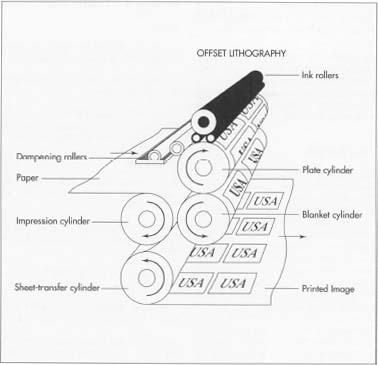

Offset printing is a commonly used printing technique in which the inked image is transferred (or "offset") from a plate to a rubber blanket, then to the printing surface. When used in combination with the lithographic process, which is based on the repulsion of oil and water, the offset technique employs a flat (planographic) image carrier on which the image to be printed obtains ink from ink rollers, while the non-printing area attracts a water-based film (called "fountain solution"), keeping the non-printing areas ink-free.
Development of the offset press came in two versions: in 1875 by Robert Barclay of England for printing on tin, and in 1903 by Ira Washington Rubel of the United States for printing on paper.
Rotogravure
Rotogravure (Roto or Gravure for short) is a type of intaglio printing process; that is, it involves engraving the image onto an image carrier. In gravure printing, the image is engraved onto a cylinder because, like offset printing and flexography, it uses a rotary printing press. Once a staple of newspaper photo features, the rotogravure process is still used for commercial printing of magazines, postcards, and corrugated (cardboard) product packaging.

Flexography
Flexography (often abbreviated to flexo) is a form of printing process which utilizes a flexible relief plate. It is essentially a modern version of letterpress which can be used for printing on almost any type of substrate, including plastic, metallic films, cellophane, and paper. It is widely used for printing on the non-porous substrates required for various types of food packaging (it is also well suited for printing large areas of solid color).


No comments:
Post a Comment